Mental Health
Resources
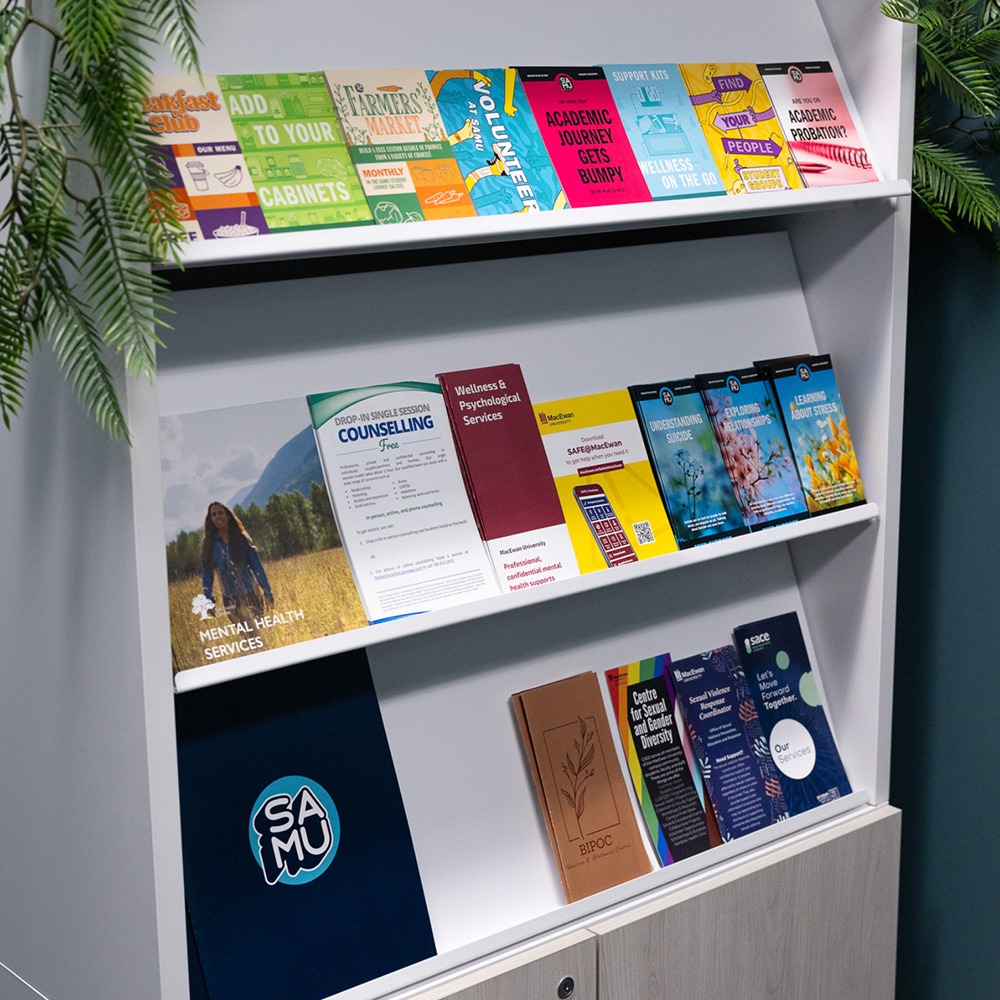
SAMU, MacEwan, and the surrounding community is home to many organizations that provide support and care. Browse through our library of resources and see what fits with your situation. If you don’t see what you are looking for, come chat with us and we’ll do our best to connect you to the right resource!
RESOURCES FOR STUDENTS
Discover resources to help you better understand mental health, relationships, identity, disability, and overall well-being. Whether you’re looking to learn, find support, or explore a topic in more depth, these guides are here to help.Quick links:
Mental Health Supports
Mental Health is a common concern for students. Learning about Mental Health can help us support ourselves and the people around us.SAMU & MacEwan Resources
SAMU Peer Support
SA-223, SAMU Building
City Centre Campus, 10850 104 Ave
For information about Peer Support, please contact the Peer Support Assistant at sapeersupport@macewan.ca.
MacEwan Wellness Psychological Services7-103A, City Centre Campus, 10700 104 Ave
780.497.5963
wps@macewan.ca
macewan.ca/safe-at-macewan/mental-health-counselling
Alberta Community Services Line
Call 211
For immediate support, please contact Distress Line
780.482.HELP (4357)
Understanding Mental Health
Some signs of struggling
Some signs that an individual may be struggling with their mental health include, but are not limited to:
Having low or excessively high energy
Isolating themselves
Eating too much or too little
Sleeping too much or too little
Problems concentrating
Inability to perform daily tasks
Dramatic changes in weight
Apathy
Feeling paranoia, worry, or anxiety
Constant irratability or anger
Substance abuse
Changes in school performance
Seeking support
Learning about Stress
Stress is often the result of high demands and is a common experience among students. Learning about stress can help us support ourselves and others.SAMU & MacEwan Resources
SAMU Peer Support
SA-223, SAMU Building
City Centre Campus, 10850 104 Ave
For information about Peer Support, please contact the Peer Support Assistant at sapeersupport@macewan.ca
Peer Health Education Team
City Centre Campus, 10850 104 Ave
https://sites.google.com/macewan.ca/phet
MacEwan Wellness Psychological Services
7-103A, City Centre Campus, 10700 104 Ave
780.497.5963
wps@macewan.ca
macewan.ca/safe-at-macewan/mental-health-counselling
Identifying Stress
Signs of stress can be physical, emotional, or behavioural.
Some common symptoms of feeling stressed include:
Problems with sleep
Irritability
Headaches
Anxiety
Indecisiveness
Identifying Stress
We can handle stress by regaining balance. We do that by increasing our coping strategies to deal with the demands.
When we look at coping, we want to do both external and internal things.
It is essential to develop a robust social system, break up your routine, take care of your body, and ask for help when needed.
There are lots of ways to cope with stress. Check out some coping strategies below to see what works best for you.
Ways to cope
Internal Coping Strategies
Exercise
Take a break
Have a nap
Watch your favourite TV show
Cook a meal
Deep breaths
Meditation
External Coping Strategies
Talk to someone you trust
Reach out to a family member to chat
Hang out with friends
Form a study group
Ask someone to be an accountability partner
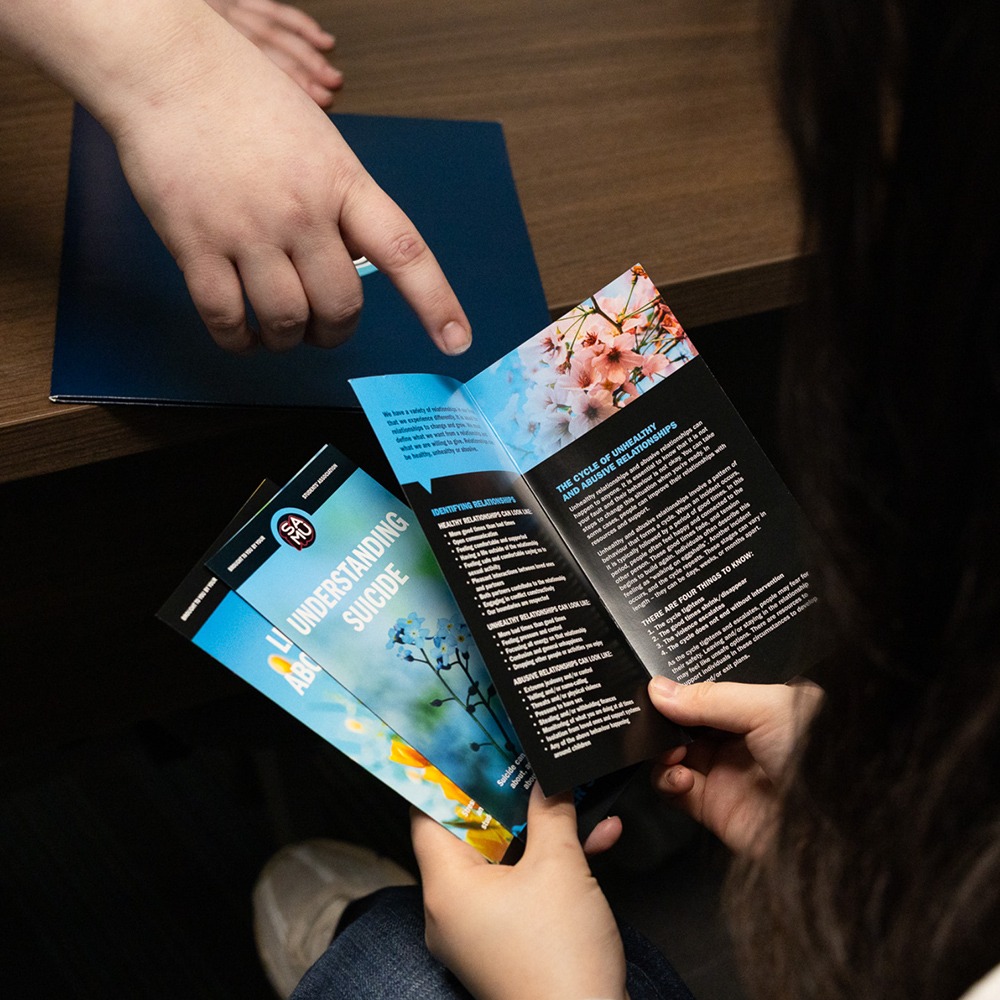
understanding suicide
Suicide can be hard for people to talk about, and it impacts us all. Talking about suicide can save lives.
It is one of the leading causes of death for young people. It can affect anyone, even if they don’t have a mental health condition.
There are several reasons why individuals die by suicide or attempt suicide. It is usually associated with helplessness, isolation, and being overwhelmed.
SAMU & MacEwan Resources
SAMU Peer Support
SA-223, SAMU Building
City Centre Campus, 10850 104 Ave
For information about Peer Support, please contact the Peer Support Assistant at sapeersupport@macewan.ca
Peer Health Education Team
City Centre Campus, 10850 104 Ave
https://sites.google.com/macewan.ca/phet
MacEwan Wellness Psychological Services
7-103A, City Centre Campus, 10700 104 Ave
780.497.5963
wps@macewan.ca
macewan.ca/safe-at-macewan/mental-health-counselling
Signs of Suicide
Suicide and Ambivalence
If you notice signs in someone you know or are experiencing suicidal thoughts, it’s okay to reach out and/or seek support. Remember, talking about it can save lives.
Exploring Relationships
All relationships in our lives look different. Learning about different relationships can help us understand if they are healthy, unhealthy, or abusive.We have a variety of relationships in our lives that we experience differently. It is usual for relationships to change and grow. We must define what we want from a relationship, and what we are willing to give.
SAMU & MacEwan Resources
SAMU Peer Support
SA-223, SAMU Building
City Centre Campus, 10850 104 Ave
For information about Peer Support, please contact the Peer Support Assistant at sapeersupport@macewan.ca
Sexual Assault Centre of Edmonton
14964 121a Avenue
780.423.4102
sace.ca
Edmonton Violence Prevention Centre
115 9303 34 Avenue
780.439.4635
edmontonvpc.ca
Identifying Healthy Relationships
Identifying unHealthy Relationships
Identifying Abusive Relationships
The Cycle of Unhealthy & Abusive Relationships
Unhealthy relationships and abusive relationships can happen ot anyone. It is essential to know that it is not your fault and their behaviour is not okay. You can take steps to change this situation when you’re ready. In some cases, people can improve their relationships with resources and support.
Unhealthy and abusive relationships involve a pattern of behaviour that forms a cycle. When an incident occurs, it is typically followed by a period of food times. IN their period, people often feel happy and connected ot the other person. These good times fade, and tension begins to build again. Individuals often describe this feeling as “walking on eggshells.” Another incident occurs, and the cycle repeats. These stages can vary in length – they can be days, weeks or months apart.
There are four things to know:
- The cycle tightens
- The good times shrink/disappear
- The violence escalates
- The cycle does not end without intervention
As the cycle tightens and escalates, people may fear for their safety. Leaving and/or staying in the relationship may feel like unsafe options. There are resources to support individuals in these circumstances to develop safety and/or exit plans.
Delving Into Self-Harm & Harm-Reduction
Self-harm is a coping strategy and harm reduction is an approach that encourages wellbeing and meets folks where they are at.
Supporting Individuals Self-Harming
If we or someone we know is self-harming, we can support them by listening to them and discussing ways they would feel comfortable making that behaviour safer.
SAMU & MacEwan Resources
What is Harm-Reduction?
Harm-reduction is an approach to addressing self-harm that doesn’t demand individuals abstain from the behaviour but instead meets people where they are at.
Harm-reduction aims to provide support that keeps an individual as safe and healthy as possible while they engage in self-harming behaviour.
Some Examples of Everyday Harm-Reduction:
Hard hats and steel-toed boots on construction sites
Seat belts in vehicles.
Wearing sunscreen while outside.
Wearing oven mitts when removing hot items from the oven.
Wearing condoms (internal or external) when having sex.
Some Examples of Harm-Reduction for Individuals
If you notice signs in someone you know or are experiencing suicidal thoughts, it’s okay to reach out and/or seek support. Remember, talking about it can save lives.
Exploring Attraction:
Experiencing Sexual & Romantic Attraction
The 2SLGBTQIA+ community encompasses many identities. Learning more about sexuality and queer identities allows us to understand and support ourselves and others.
SAMU & MacEwan Resources
Centre of Gender and Sexual Diversity
Roundhouse 11-159, Allard Hall, 11110 – 104 Avenue
Mon to Fri, 9 AM to 5 PM
780.497.4363
csgd@macewan.ca
Website link
Pride Centre of Edmonton
2nd Floor, 10618 105 Avenue NW
780.488.3234
hello@pridecentreofedmonton.ca
pridecentreofedmonton.ca
Canadian Mental Health Association (CMHA)
CMHA Alberta Division
320 Ledgeview Business Centre
9707 – 110 Street NW
780.482.6576
alberta@cmha.ab.ca
alberta.cmha.ca
211
More information about resources available in Edmonton and Alberta is accessible by calling 2-1-1.
Asexual people who don’t experience sexual attraction but still desire to engage in sexual behaviour or a sexual relationship.
People who identify in the grey area of the sexual attraction spectrum and do not explicitly and exclusively identify as asexual or aromantic. They may experience limited sexual attraction to others.
People who only experience sexual attraction to those with whom they have an emotional bond (demisexuals are on the asexual spectrum).
People who experience little or no romantic attraction to others and lack interest in forming romantic relationships.
Women who are exclusively attracted to other women/femmes.
Men who are sexually attracted to other men/mascs exclusively are also used as an umbrella term for people who are sexually attracted to more than one gender.
People who experience sexual attraction to more than one gender.
People whose gender identity does not match the sex they were assigned at birth. Among others, the term “transgender” includes those who identify as transsexual, non-binary, genderqueer, or simply just transgender.
People with non-normative gender identity, sexual orientation, or sexual anatomy – can include lesbians, gay men, bisexual people, transgender people, and other identities.
Exploring one’s gender identity, gender expression, and sexual orientation. Some folks may also use this term to name their identity within the 2SLGBTQIA+ community.
People who may have the genes that people may associate with being male or female, but their reproductive organs, genitals, or both may look different.
People who experience little or no sexual attraction or a desire for partnered sexuality. Some asexual people are celibate, and others do have sex. There are many ways of being asexual.
People who experience romantic attraction, but not sexual attraction, to people of more than one gender.
This romantic orientation describes people who experience romantic attraction only under specific circumstances, such as after building an emotional relationship with a person.
People who are sexually attracted to those with non-cisgender gender identities, such as people who are non-binary, genderqueer or trans.
Exploring Gender Identity
How people understand gender and the language around it is vast. Here is some information to help us understand our own and others’ gender.
SAMU & MacEwan Resources
Centre of Gender and Sexual Diversity
Roundhouse 11-159, Allard Hall, 11110 – 104 Avenue
Mon to Fri, 9 AM to 5 PM
780.497.4363
csgd@macewan.ca
Website link
Pride Centre of Edmonton
2nd Floor, 10618 105 Avenue NW
780.488.3234
hello@pridecentreofedmonton.ca
pridecentreofedmonton.ca
Canadian Mental Health Association (CMHA)
CMHA Alberta Division
320 Ledgeview Business Centre
9707 – 110 Street NW
780.482.6576
alberta@cmha.ab.ca
alberta.cmha.ca
211
More information about resources available in Edmonton and Alberta is accessible by calling 2-1-1.
The pronouns a person uses correlate with their gender identity and how people should address or refer to them
(Examples of pronouns: they/them, she/her, he/him, ze/hir, she/they, he/they, none)
It is important to remember that we do not call people “it,” as this has been used as a trans and genderqueer slur historically.
Based on certain biological factors (such as reproductive organs, genes, and hormones).
Your sex assigned at birth does not match your sexual identity, and you do not identify within the binary.
(Example: you were assigned female at birth, but you don’t identify as a man or a woman) (Pronouns: they/them, he/they, she/they)
The idea/construct that there are only two genders (men and women); this also extends to sexes (male and female). There are more than two genders and sexes. The binary does not include all identities and bodies.
Does not have a gender or identify with a gender.
(Pronouns: May not use pronouns and must be referred to by name only)
Identifies having two genders.
(Pronouns: May have two sets of pronouns used at different times)
Identifies with and experiences/displays parts of multiple genders.
(Pronouns: There may be multiple sets of pronouns or just one depending on the individual)
Identifies with and experiences all genders.
(Pronouns: often uses all pronouns)
How someone identifies internally and expresses externally (people may use clothing, appearance, and behaviour to express the gender they identify with. This often involves people’s ideas of masculinity and femininity).
Your sex assigned at birth does not match your gender identity and may or may not identify within the binary.
(Example: you were assigned male at birth, but you identify as a woman) (Pronouns: he’him, she/her, they/them, she/they, he/they)
Your sex assigned at birth matches your gender identity, and you identify within the gender binary of man or woman.
(Example: you were assigned female at birth, and you identify as a woman.) (Pronouns: she/her, he/him)
A person may have the genes that people may associate with being male or female, but their reproductive organs, genitals, or both may look different.
Refers to a person’s understanding and relationship with their gender.
Refers to how a person expresses themselves to others and how they want the world to see them.
Your gender identity and presentation shift between or outside society’s expectations for the assigned sex or assumed gender.
(Example: you were assigned male at birth, and some days people perceive you as a man, and other days perceive you as a woman or neither).
(Pronouns: Gender Fluid/Gender Queer folks may have any combination of pronouns, use different ones at specific times, or respond to any pronouns at all times. It’s up to the individual)
Two Spirit is an umbrella term encompassing different sexualities and genders in Indigenous communities. There are many definitions of Two Spirit, which may or may not describe Indigenous peoples’ experiences and feelings of masculinity and femininity. This cultural term is for people who identify as Indigenous.
Two Spirit people may or may not identify as part of the LGBTQIA+ community, because they transcend colonial definitions of gender and sexuality.
Understanding Disability
Disability can look many ways and is multifaceted. Understanding disability can help us learn how to best respect and support ourselves and others.
People with disabilities/disabled people are whole people with a broad spectrum of interests, emotions, and experiences. We can respect and support folks with disabilities by learning more about disability and checking our biases at the door.
SAMU & MacEwan Resources
Access and Disability Resources MacEwan (ADR)
7-166, City Centre Campus, 10700 104 Ave
Mon – Fri, 8:30 AM – 4:30 PM
780.497.5886
myaccess@macewan.ca
macewan.ca/adr
City of Edmonton Resources
edmonton.ca
Alberta Government Information
alberta.ca
211
More information about Resources available in Edmonton and Alberta is accessible by calling 2-1-1
Relevant Terms
Exploring what disability looks like
Perceptions of People with Disabilities/Disabled people & Supporting the disabled community
Things we can do to support the disabled community